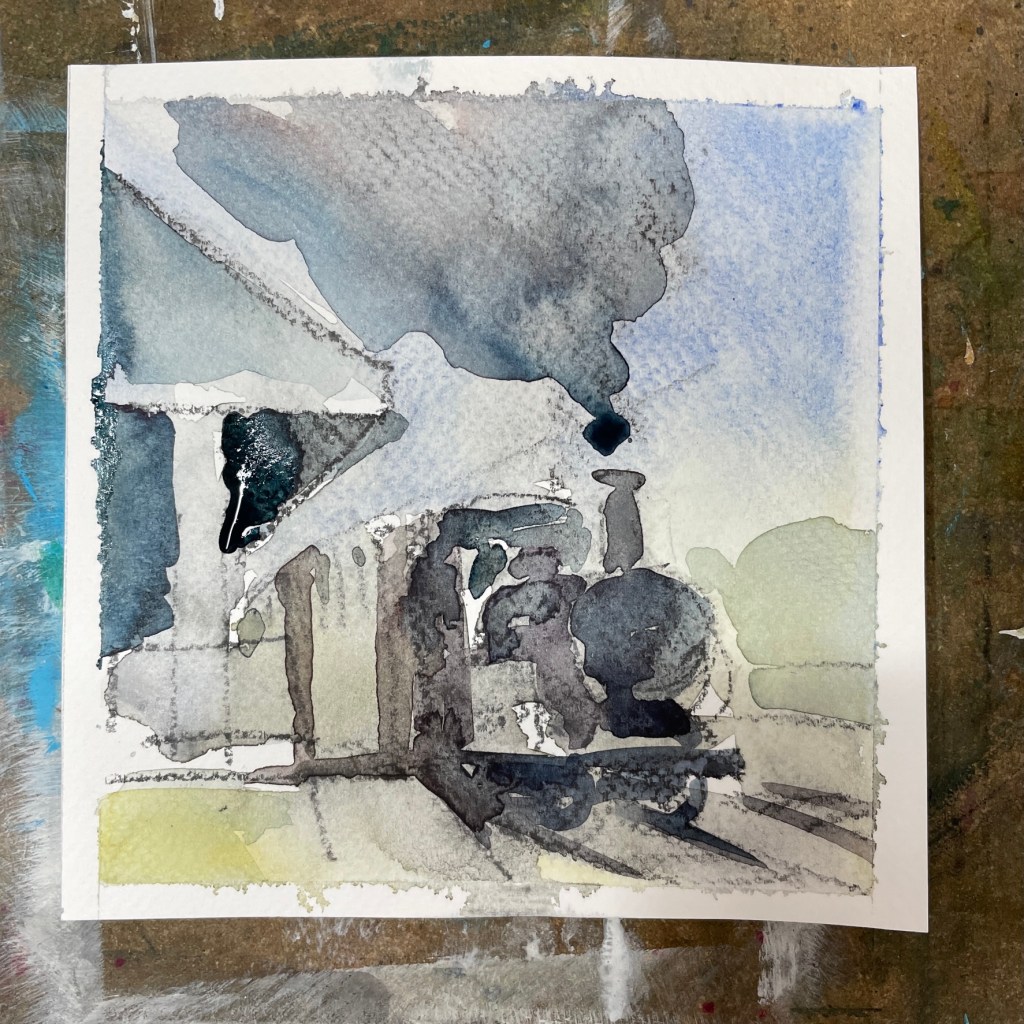
Aubergine

There was a time when I would have interpreted the Doodlewash prompts literally…and today would have been a picture of an Aubergine. Today’s image is a development of an idea from my sketchbook. I’ve ignored the prompt!

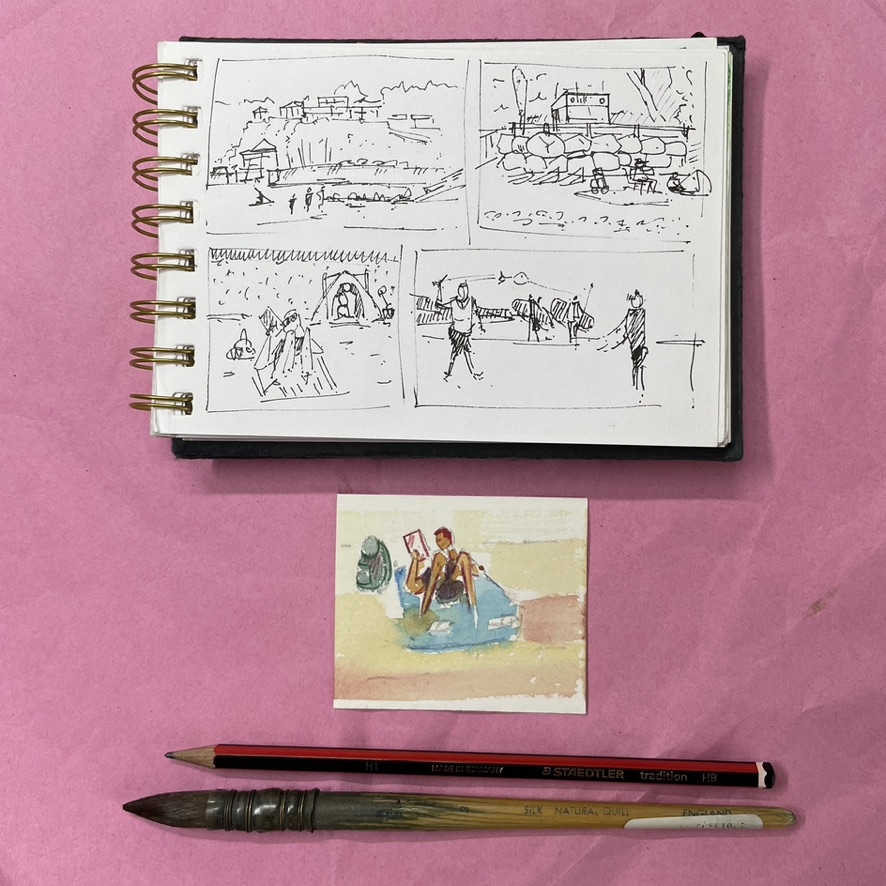
The sketches on this page took roughly 5 minutes each. There is hardly any details and the lines are scratchy and fast. In my mind I can picture them in full colour and I can see what the final image should look like.

The paddle board was dark against the sky, the people were moving with intent and excitement. I had in mind to turn this into a collage piece. I like to create images in threes and this would be joined with a boat at sea and perhaps a diver or a beach rock pool adventure. The ideas are still developing and this is how I work. I’m never sure of what I want to create, inspiration flows from one sketch to the next.

The next step for this image will be a larger version that will iron out any compositional details. Stay tuned this may be a new series of paintings…

Day 14 Complete.
Valuable

The most valuable piece of advice I would give to beginner watercolorists is – Don’t give up, make mistakes.

I’m not sure that today’s image is anatomically correct, it is copied from a sketch and it has a lot of errors.

But you can learn a lot from mistakes. The bled of beach colour over the blue mat is due to a property of yellow paint, it will always push other colours away. And you can use this to help correct mistakes, or in this case make mistakes. I wanted the sand to seem like it had brushed up over the mat.

The head of the person is not quite right. It gives the impression that there may be 2 people in the image. Is this a mistake or is this to introduce interest to the viewer? Always give the viewer of your paintings something to think about.

The original sketch featured a beach tent in the background. This would have confused the painting and added too much detail, distracting from the main subject. I’ve developed the rucksack from the sketch to give some balance to the image.

So next time you make a mistake in a painting – stop and think. Is this a mistake or adding interest?

Day 13 Done.

Otherworldly

Day 12 of World Watercolor Month – I’m just about getting used to the American spelling of watercolour. But I don’t like it!

Otherworldy – I’ve taken a different approach to colour recently. I no longer strive to get the correct colour in my paintings. I’m more interested in tone and shape. This does give my pictures a otherworldy quality.

My basic palette is primary colours which I can mix all the colours I need. I use a combination of warm and cool primaries. Mixing warm and cool colours together gives a dulled version while mixing warm colours together brings out all the lovely bright colours.

I never used to like practising mixing colour, but there is a lot of value in this exercise. Mingling watercolours together and watching how they mix is a very relaxing and mediative therapy after a long day!

Day 12 done!

Element

World Watercolor Month – day 11 – A busy scene if full of elements that must be simplified to work in a watercolour. Don’t get distracted by detail to soon.

I like to do an initial wash across the whole painting, allowing the colours to touch and mingle. It is quite a leap of faith for some people to see this in action. The painting at this point will look quite a mess!

Once dried and the colours have lightened I refer back to my original grey scale image and look for the next set of dark tones. I can apply these quickly to the painting using the original set of colours in my palette. The layering of colour builds the tone up.

My method then is to touch the paper three times in this way building up tone only where it is needed. My initial layers are left alone which creates a feeling of light and depth.

If colour becomes confusing – try creating a monochrome image using one colour. Don’t limit yourself to black! Try red’s, blues yellows and browns.

Contrast is your friend when it comes to watercolour.

Day 11 complete!

Clutter

The irony of todays image is the lack of clutter.

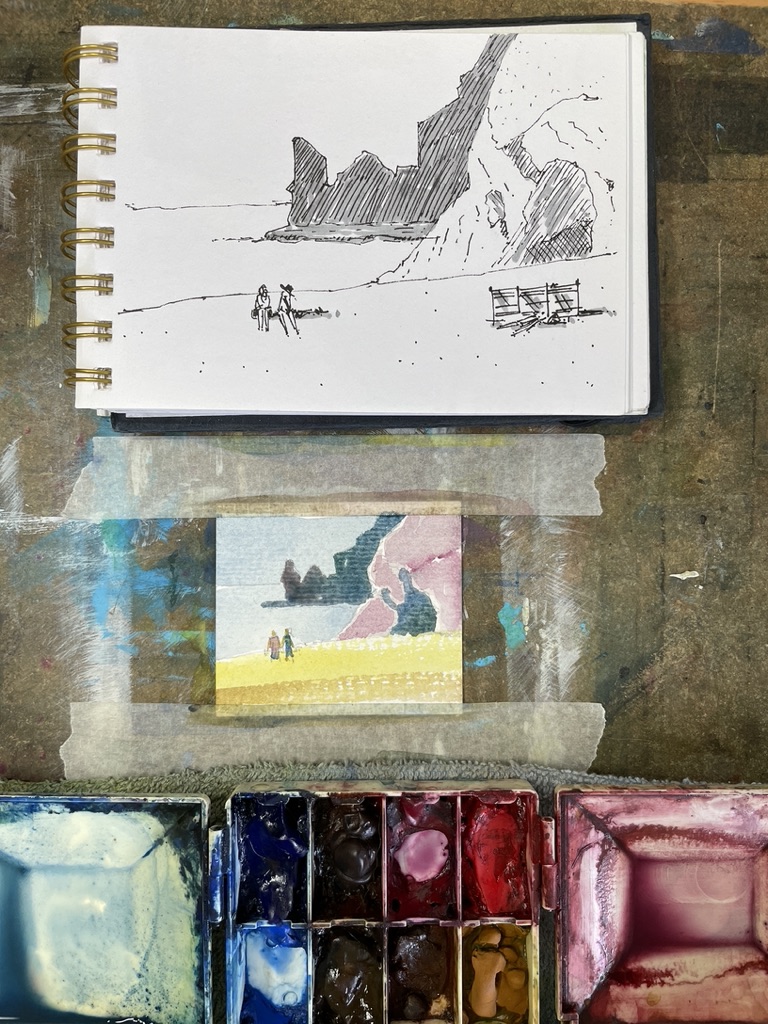
Penbryn beach is a national trust owned coastline. It was the most empty beach I have ever been on, despite a full car park. The light in the image was bizarre in that the hills were really dark and I wanted to capture that against the light of the beach.

When I came to draw the image the beach had really filled out with 2 people walking along the shoreline. The beach itself was deceptive as there was a drop where the tide had gone out and the dry sand. It made it look like people had no legs as they walked.

There is some really great dry brush work in this little test piece. The best way to achieve dry brush is to move the brush as quickly over the surface of the paper, don’t push down on the hairs and use a lightly more pigmented mi of paint. I’ve heard this referred to as sticky paint in the past…I’ll explain. Paint that is not a wet wash, but more the consistency of paint straight from the tube.

Day 10 Complete.

Vegetation

I am enjoying working from my little sketchbook, so I have stopped using the Doodlewash optional prompt! Well, almost.

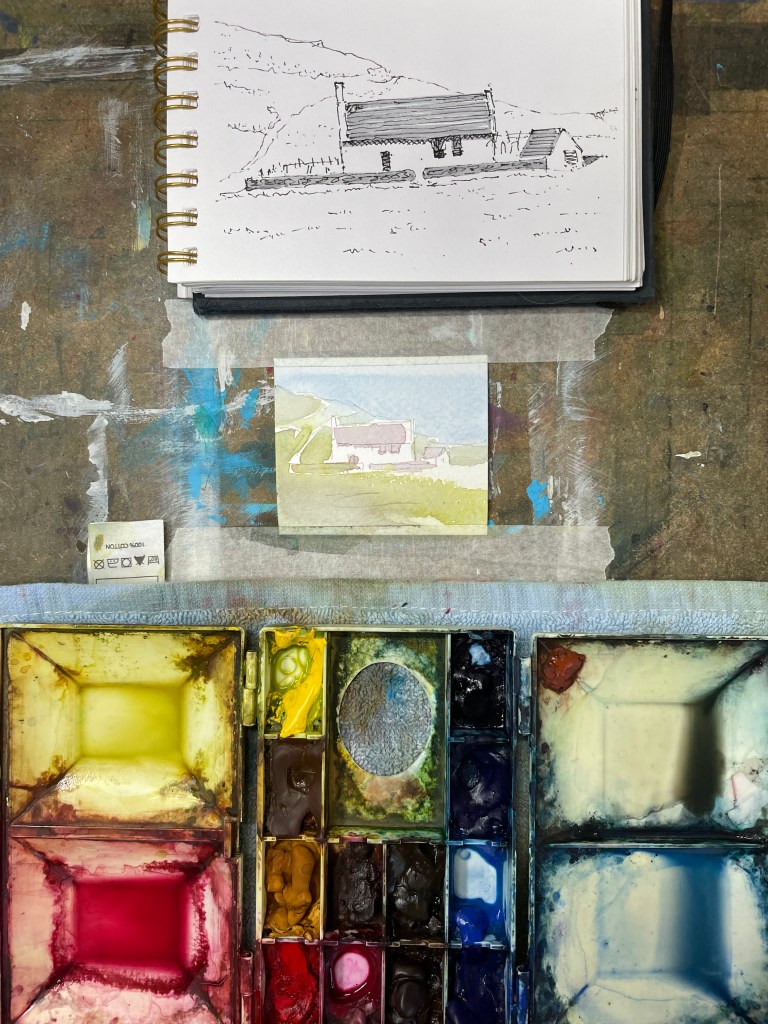
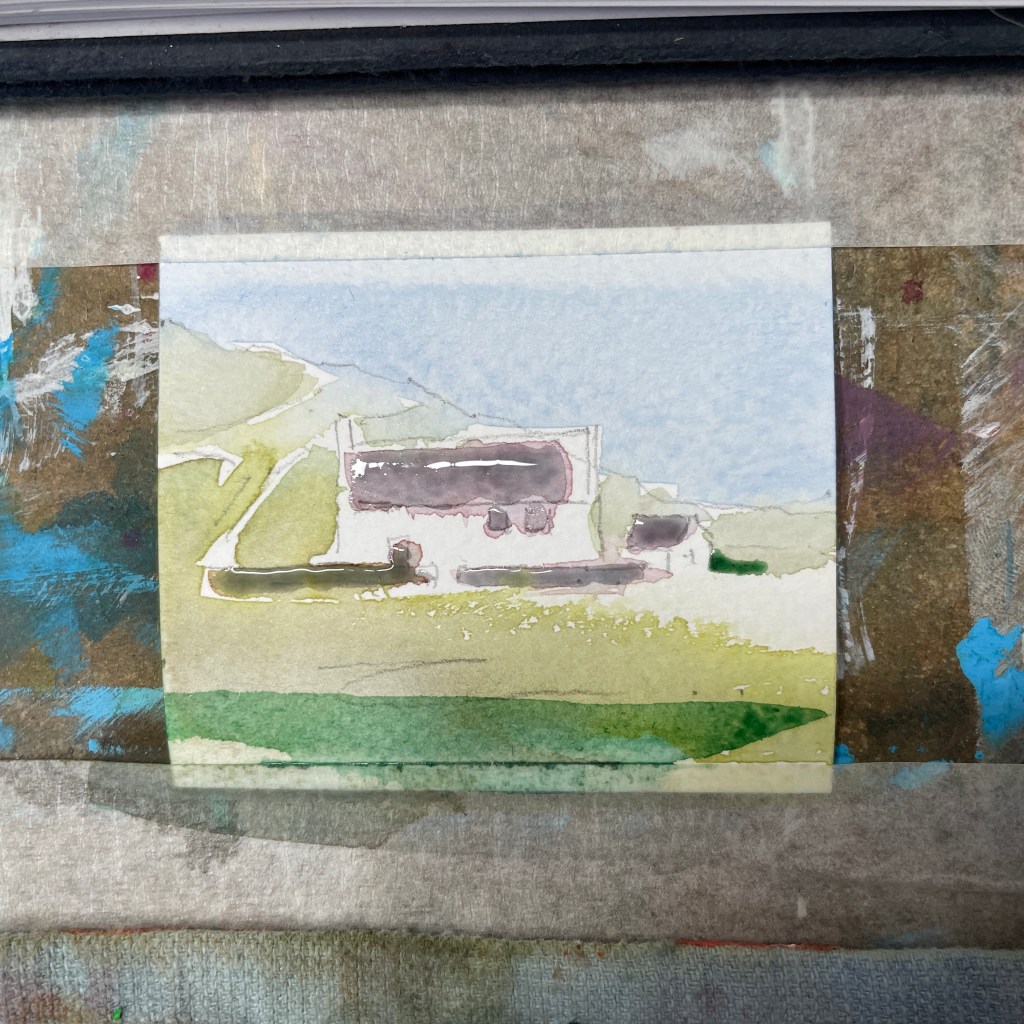
This image is a little bit of MWNT in Wales. when the tide goes out you can walk along the bank of the river to the pub! I have struggled to paint this picture many times and so I have really tried to simplify the sketch in this small watercolour. In the interests of Doodlewash, world of watercolor month – There is some vegetation in the image.

I like the poles sticking out of the ground. This was a favourite device of Edward Wesson to indicate water by showing the reflections in water. I think this is what drew me to the scene in the first place and in my previous attempts at the picture the thing that has got lost.

I may try to create this image again but with the horizon lower on the page to really get the vertical-ness of the poles to shine through.

Food for thought,

Day 9 compelete.

Mechanism

Beginners to watercolour are often troubled by the mechanics of the medium. It is different from opaque art materials such as oils and acrylics and so easy to mix a muddy colour.

I like to keep my palette in a very ordered state and I tend to paint with only primary colours. Red, yellow and blue. I then have a separate area for mixing tertiary colours. As you can see above.

I do this because of some advice I heard years ago…If you want clean washes keep your palette clean – Mucky Palette will equal a muddy wash.

I’ll talk more about warm and cool colours in a later post.

Todays image is another one developed from my sketch book. This is the path from Aberporth to Tresaith. Its been recently pathed for easy access but two thirds of the way to Tresaith it turns to a muddy track, most unsuitable for accessibility! However it is a very nice walk.

Day 8 done.

You Lemon!

I re-read the articles in the Painter magazine last night and I also thought about my own sketchbook practice. So today, not using the Doodlewash Prompt of Lemon, I am going to describe my water colour practice.

Everything I do starts with a sketch. These are generally made on location in a little A6 sketch book. If not they are made from random photos that I take on my phone. I then use either pencil or grey scale pens to give my image some depth and tone.

Back in the studio, (very grand term for our small office), I will then make tiny water colour images, these are matchbox size off-cuts of watercolour paper. A tip I picked up from reading articles by Neil Meacher.

I will get a collection of these images in my sketchbook and they generally fall out and get very slightly on my nerves. I used to stick them in my sketchbook but I started to use both sides of my paper and I ran out of room.

Very slightly, side tracked there! I use these small images to paint the initial washes of larger paintings. I don’t refer back to the photo until the last detail stages of the painting. These enables me to simplify my image and concentrate on what initially drew me to draw a scene.

Working at a small scale with a big brush is very liberating.

Day 7 Complete.

Flavor?

It is safe to say that I am so far off the doodlewash topic prompt today and in quite a mess. I have reviewed the week’s work so far, and I am happily on a journey of discovery with collage and watercolour.

One thing I’ve noticed is how different materials can have various effects on the watercolor application and drying process. Lately, I’ve been incorporating gouache into my paintings to strengthen the images, and I’m excited to experiment with acrylic gouache in my upcoming works. Additionally, I’ve been enjoying the beautiful range of gray colors achieved with soluble graphite sticks. However, finding the right balance between paint and graphite has proven to be a bit challenging.

To further enhance my artistic exploration, I’ve been diving into the August edition of The Painter magazine. It features some truly interesting articles that have caught my attention. Steven Griggs offers valuable advice on how to loosen up and break free from the confines of our artistic practices. Jenny Attkins, on the other hand, explores the use of light to make paintings sparkle, which I find inspiring.

I started with a college base that established the main areas of the painting. And then the trouble started. Adding colour to the image was not a success and so further drawing was required to bring back some details. However I had already lost the image!

I simplified the image further in a quick 5 minute painting.

Why would I post an image that is not finished and is not what I consider to be my best work? While today’s doodlewash, may have veered off the initial topic, it has led me on a captivating journey of discovery. Exploring new materials, drawing inspiration from fellow artists, and experimenting with various techniques has enriched my artistic process.

As artists, we must always be open to detours and unexpected paths, for it is within these twists and turns that we often find the most rewarding artistic breakthroughs.

Startle

I was scared to start a month long project based around watercolour, having become very effective with collage techniques. But I am finding a lot of freedom to experiment with watercolour and push the boundaries of what is possible.

While Gouache is not strictly watercolour, it is still a water-based medium and allowed by Charlie on Doodlewash!

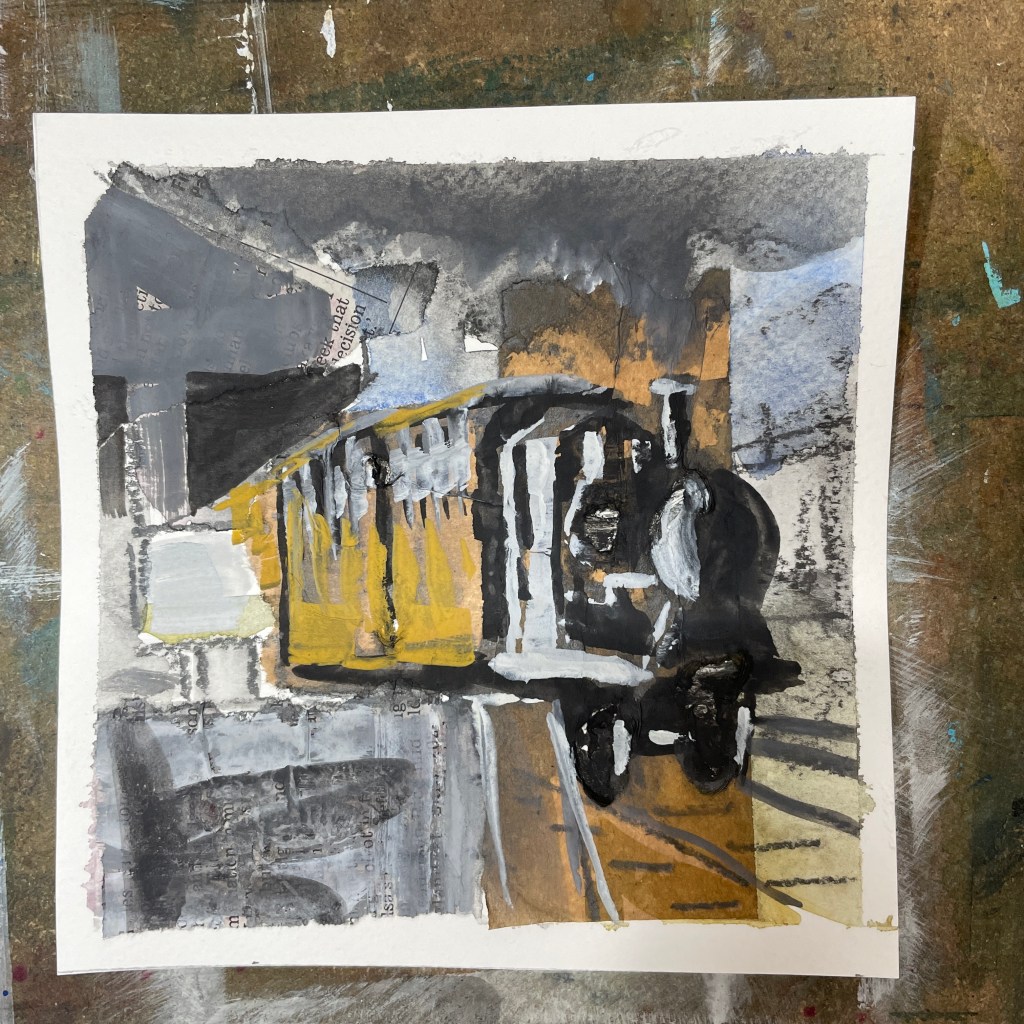
My dad was a mechanic, preferring older style engineering to the more modern electrical ignition systems. I found a black and white image of a mechanic, probably from the late 70’s and I’ve used this as my inspiration today.

You wouldn’t want to ‘startle’ the mechanic(!) – got to get the theme in somehow. I’ve used collage and watercolour to start the image and then worked over the top with gouache.

This has really given me some food for thought about how to develop a collage and watercolour technique. I shall be sharing some timelapse videos of this technique later in the week.

Day 4 – a developing story.